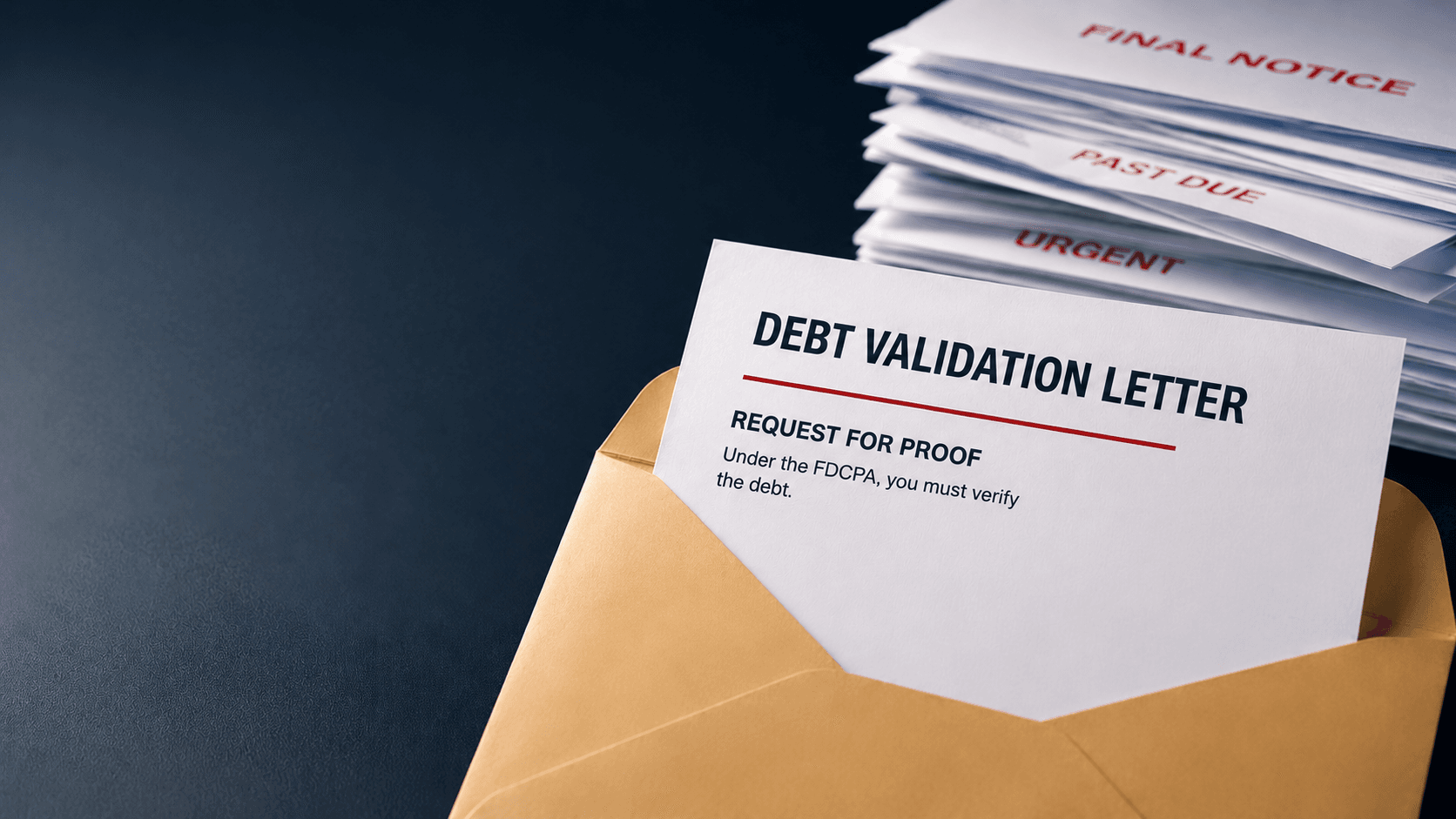
Key Takeaways
5 points- A debt validation letter forces collectors to prove you owe the debt before continuing collection
- You must send it within 30 days of their first contact for maximum legal protection
- The collector must stop all collection activity until they send verification
- If they can't verify, they must stop collecting and remove credit reporting
- If they ignore your letter, they're violating the FDCPA and you can sue
Introduction
If a debt collector contacts you about a debt, you have the legal right to demand proof that you actually owe it. This proof is called debt validation or debt verification, and you request it by sending a debt validation letter.
Under the Fair Debt Collection Practices Act (FDCPA), debt collectors must stop all collection activity until they send you verification of the debt. If they can't prove you owe it, they cannot legally continue trying to collect.
This guide explains what a debt validation letter is, why it's one of your most powerful tools against debt collectors, how to write one, what happens after you send it, and includes a free template you can use today.
What Is a Debt Validation Letter?
A debt validation letter (also called a debt verification letter) is a written request you send to a debt collector demanding proof that you owe a specific debt. The letter invokes your rights under federal law to force the collector to verify the debt before continuing collection efforts.
What the letter accomplishes:
Stops collection activity until they send proof
Forces them to verify the debt is yours and the amount is correct
Protects you from paying debts you don't owe
Creates a paper trail if they violate your rights
Buys you time to assess the situation and consider your options
Important: A debt validation letter is not the same as disputing a debt on your credit report. This letter goes to the collection agency, not the credit bureaus.
Why Should You Send a Debt Validation Letter?
Many people make the mistake of ignoring debt collectors or immediately making payment arrangements. Sending a debt validation letter first is almost always the smarter move, even if you think you might owe the debt.
Reasons to send a validation letter:
The debt might not be yours - Identity theft, clerical errors, and mistaken identity are common. The collector might have the wrong person.
The amount might be wrong - Collectors often add unauthorized fees, interest, or charges that inflate the actual debt.
The debt might be too old - If the debt is beyond the statute of limitations in your state (typically 4-5 years in Florida), they cannot legally sue you to collect it.
The debt might have already been paid - Payment processing errors happen, and you might have already settled this debt.
The collector might not own the debt - Debt buyers purchase portfolios of thousands of debts. Sometimes they buy debts they don't actually have legal ownership of.
You need time - The validation process gives you 30 days (plus the time it takes them to respond) to research the debt, consult an attorney, or plan your next steps.
They might not be able to prove it - Many collectors cannot actually verify debts, especially old ones or debts that have been sold multiple times. If they can't prove it, they must stop collecting.
Your Legal Rights Under the FDCPA
The Fair Debt Collection Practices Act gives you specific rights when dealing with third-party debt collectors.
What collectors must do:
Within 5 days of first contacting you, collectors must send you a written validation notice that includes:
The amount of the debt
The name of the creditor you originally owed
A statement that you have 30 days to dispute the debt in writing
A statement that if you request verification in writing, they must provide it before resuming collection
What happens if you send a validation letter:
If you send a written dispute or request for verification within 30 days of receiving their validation notice, the collector must:
Stop all collection activity immediately
Obtain verification of the debt from the original creditor or previous owner
Mail you the verification before resuming any collection efforts
What they cannot do:
Continue calling you demanding payment while your dispute is pending
Report the debt to credit bureaus as verified when it's still under dispute
Threaten legal action without providing verification first
Add fees or interest that aren't authorized
If a collector violates these rules, you can sue them for FDCPA violations and recover up to $1,000 plus attorney's fees.
What Must Be Included in Debt Verification?
When a debt collector sends verification, it must include sufficient proof that:
You are the person who owes the debt - They need to show your name, address, and identification match the original debtor.
The debt is yours - Documentation showing you opened the account or received the goods/services.
The amount is accurate - An itemized breakdown showing the original amount, any interest, and authorized fees.
They have the legal right to collect - Proof they own the debt or are authorized by the creditor to collect it.
Acceptable verification includes:
A copy of the original contract or agreement you signed
Account statements showing charges and payments
A chain of title showing the debt was legally sold to them
An itemized breakdown of the current balance
NOT acceptable verification:
A computer printout with just your name and a balance
A letter claiming "we verified it with the original creditor"
Screenshots or incomplete records
Documents that don't match the amount they're trying to collect
How to Write a Debt Validation Letter
A debt validation letter should be clear, direct, and professional. You don't need to explain why you're requesting validation or provide details about your financial situation.
Key elements to include:
Your contact information - Your name and mailing address (use a safe address, not necessarily your home address if you're concerned about privacy).
Date - Always date the letter.
Collector's information - The name of the collection agency and the address they provided in their validation notice.
Reference numbers - Include any account numbers, reference numbers, or case numbers they provided.
Clear validation request - State directly that you are requesting validation of the debt under the FDCPA.
Specific information requested - List what you want them to provide as proof.
Instruction to cease contact - Optionally include a request to stop calling you while the dispute is pending.
Your signature - Sign the letter.
Do NOT include:
Explanations of why you don't owe the debt
Personal financial information
Payment history unless relevant to the dispute
Emotional language or threats
Free Debt Validation Letter Template
Here's a template you can customize and send:
[Your Name]
[Your Address]
[City, State ZIP]
[Date]
[Collection Agency Name]
[Collection Agency Address]
[City, State ZIP]
RE: Account Number [insert account number]
To Whom It May Concern:
This letter is a formal request for validation of the debt you claim I owe, as allowed under the Fair Debt Collection Practices Act (15 U.S.C. § 1692g).
I am disputing this debt and requesting that you provide the following information:
Proof that you are licensed to collect debts in my state
A copy of the original contract or agreement showing I owe this debt
An itemized accounting of the amount you claim is owed, including the original creditor's charges and any interest, fees, or charges you have added
Proof that you own this debt or are authorized to collect it, including a complete chain of custody from the original creditor to you
The name and address of the original creditor
Verification that the statute of limitations has not expired on this debt
Until you provide proper verification of this debt, I request that you:
Cease all collection activity
Stop reporting this debt to credit bureaus as verified
Do not contact me by phone
I understand that under the FDCPA, you must cease collection efforts until you have provided proper verification of this debt. I also understand that if you cannot verify this debt, you must cease all collection activity and remove any negative reporting from my credit reports.
Please send all correspondence to the address listed above. I do not give permission for you to contact me by phone or at my place of employment.
Sincerely,
[Your Signature]
[Your Printed Name]
Reminder
Keep a copy of this letter for your records. Send it via certified mail with return receipt requested so you have proof of delivery.
How to Send Your Debt Validation Letter
Step 1: Send it in writing
Never request validation over the phone. The FDCPA requires written requests to trigger the verification requirement.
Step 2: Use certified mail
Send the letter via USPS Certified Mail with Return Receipt Requested. This costs a few dollars but gives you proof the collector received your letter.
Step 3: Keep copies of everything
Make a copy of the letter before mailing it
Keep the certified mail receipt
Keep the return receipt when it comes back
Save these documents with your debt records
Step 4: Send it within 30 days
You have 30 days from the date you receive the collector's initial validation notice to send your request. After 30 days, they can assume the debt is valid and resume collection.
However, even if 30 days have passed, you can still send a validation letter. The collector should still provide verification, though they may not be legally required to stop collection during the dispute period.
Step 5: Don't make any payments
Do not send money while waiting for verification. Making a payment can be interpreted as acknowledging the debt is valid.
What Happens After You Send a Debt Validation Letter?
Once the collector receives your letter, several things should happen:
They Must Stop Collection Activity
The collector must immediately cease all collection efforts, including:
Phone calls demanding payment
Letters threatening legal action
Attempts to withdraw money from your account
Wage garnishment proceedings
Lawsuits (they must pause legal action until they verify)
Exception: They can contact you once to confirm they received your letter and are ceasing contact, or to notify you they're taking a specific action like filing a lawsuit.
They Must Send Verification
The collector must obtain verification from the original creditor or previous debt owner and mail it to you. There is no specific deadline in the FDCPA for how quickly they must respond, but most respond within 30-60 days.
Three Possible Outcomes
Outcome 1: They send proper verification
If they provide legitimate proof that you owe the debt, you'll need to decide your next steps:
Set up a payment plan
Negotiate a settlement for less than the full amount
Consult a consumer rights attorney to review the verification and advise you
Outcome 2: They cannot verify the debt
If they can't prove you owe the debt, they must:
Stop all collection efforts permanently
Remove any negative information from your credit reports
Not sell or transfer the debt to another collector
Outcome 3: They ignore your letter
If they continue collection activity without providing verification, they are violating the FDCPA. Document every contact and consult an attorney immediately. You may have grounds to sue them for damages.
What If the Debt Collector Ignores Your Letter?
If a collector continues calling, sending letters, or threatening legal action after receiving your validation letter, they are breaking federal law.
Steps to take:
Document the violations - Keep call logs, save voicemails, and preserve all letters they send.
Send a follow-up letter - Send another letter via certified mail stating they violated the FDCPA by continuing collection without providing verification.
File complaints - Report the violation to:
Consumer Financial Protection Bureau (CFPB)
Federal Trade Commission (FTC)
Your state Attorney General
Consult an attorney - Contact a lawyer who handles FDCPA violations. You can sue for up to $1,000 plus attorney's fees, and the collector must pay your legal costs if you win.
What If the Verification Looks Incomplete or Wrong?
Not all verification is equal. If the collector sends documents that don't adequately prove the debt, you can dispute their verification.
Common problems with verification:
Missing documentation - They send a balance printout but no original contract.
Incorrect amounts - The balance they're claiming doesn't match the documentation.
No proof of ownership - They can't show they legally own the debt or are authorized to collect it.
Photocopies without originals - In some cases, especially for very old debts, photocopies may not be sufficient proof.
If verification is inadequate, send another letter pointing out the deficiencies and requesting proper documentation.
Can You Send a Debt Validation Letter After 30 Days?
Yes, but your legal protections are weaker.
If you send a validation letter within 30 days of receiving the collector's initial notice, they must stop collection until they verify.
If you send it after 30 days, the law does not require them to stop collection while they verify. However, they should still respond to your request, and many will pause collection anyway to avoid potential violations.
Bottom line: Send the letter as soon as possible, but even a late letter is better than no letter.
Does a Debt Validation Letter Remove the Debt from Your Credit Report?
Not automatically, but it can lead to removal.
Sending a validation letter to the collector does not automatically remove the debt from your credit report. However:
If they can't verify - If the collector cannot verify the debt, they must stop collection and remove any negative reporting.
If you dispute with credit bureaus - You should also dispute the debt directly with the credit bureaus (Equifax, Experian, TransUnion) by sending a separate dispute letter.
If they violated the FDCPA - If they reported the debt as verified while your validation request was pending, that may be a violation you can use to force removal.
Debt Validation Letter vs. Cease and Desist Letter
These are two different tools:
Debt validation letter - Requests proof of the debt and pauses collection until verification is provided.
Cease and desist letter - Demands the collector stop all contact with you permanently.
Key difference: A cease and desist letter stops communication but does not make the debt go away. The collector can still:
Report the debt to credit bureaus
Sue you to collect the debt
Sell the debt to another collector
A validation letter, by contrast, forces them to prove the debt exists before taking any of those actions.
Which should you use?
If you want proof before deciding next steps: Validation letter
If you're certain the debt isn't yours or you don't want any contact: Cease and desist letter
If you want both: Send a validation letter that includes a request to stop phone calls
What About Time-Barred Debts?
If a debt is beyond the statute of limitations in your state, the collector cannot sue you to collect it. In Florida, the statute of limitations for most consumer debts is 4-5 years depending on the type of debt.
Important considerations:
They can still try to collect - Even if the debt is time-barred, collectors can still contact you and ask for payment. They just can't sue you.
Don't restart the clock - Making a payment, acknowledging the debt in writing, or making a payment arrangement can restart the statute of limitations, giving them the right to sue again.
Your validation letter should ask - Include a request for them to confirm the date of last activity and whether the statute of limitations has expired.
If the debt is time-barred and they threaten to sue, that's an FDCPA violation.
Common Mistakes to Avoid
Don't provide unnecessary information - Keep your letter simple. Don't explain your financial situation or give details about why you don't owe the debt.
Don't make a payment - Making any payment while waiting for verification can be seen as acknowledging the debt is valid.
Don't use emotional language - Stay professional. Angry or threatening language doesn't help your case.
Don't ignore follow-up collection attempts - If they violate the law by continuing collection without verification, document it and consider legal action.
Don't forget to send it within 30 days - Your strongest legal protections apply when you send the letter within 30 days of their first contact.
Don't skip certified mail - Always send via certified mail with return receipt. Proof of delivery is critical if you need to enforce your rights later.
What If You Actually Owe the Debt?
Even if you think you owe the debt, you should still send a validation letter.
Why?
The amount might be wrong - Collectors often add unauthorized fees and interest.
You might qualify for a settlement - Once you confirm the debt is valid, you can negotiate to pay less than the full amount.
It gives you time - The 30-day window plus verification period gives you time to assess your options and consult an attorney.
It protects your rights - Ensuring the collector follows the law protects you from harassment and abuse.
After receiving verification, if the debt is legitimate, you can:
Negotiate a settlement for a lump sum payment
Set up a payment plan
Request a "pay for delete" agreement (they remove negative credit reporting in exchange for payment)
Consult a Florida consumer rights attorney about your options
Frequently Asked Questions

Free Consultation
Were your rights violated?
Free Consultation
Were your rights violated?
We fight for consumers — no upfront cost, no fee unless we win. (561) 264-7211
Consumer Law Florida · Licensed Florida attorneys · Serving clients statewide by phone & video